

A Practical Overview of the Michigan Driver's License Restoration Process
Living in Michigan without a valid driver's license is more than inconvenient. For many people, it is nearly impossible. Work, medical appointments, school, family obligations, treatment, probation, and ordinary daily life all depend on the ability to drive lawfully. When repeat drunk driving convictions cost a person his or her license, the loss reaches every corner of life. It affects employment, income, housing stability, family responsibilities, and the long process of rebuilding.
That hardship is real, but hardship alone does not restore a revoked Michigan driver's license. Years ago, drivers often turned to the circuit court for hardship-based relief. That is no longer how repeat alcohol-related revocation cases are decided. A person whose license has been revoked must proceed through the Michigan Secretary of State's administrative hearing process, still commonly called the DLAD or DAAD, although the formal name is now the Administrative Hearings Section.
A Suspension Is Not the Same as a Revocation
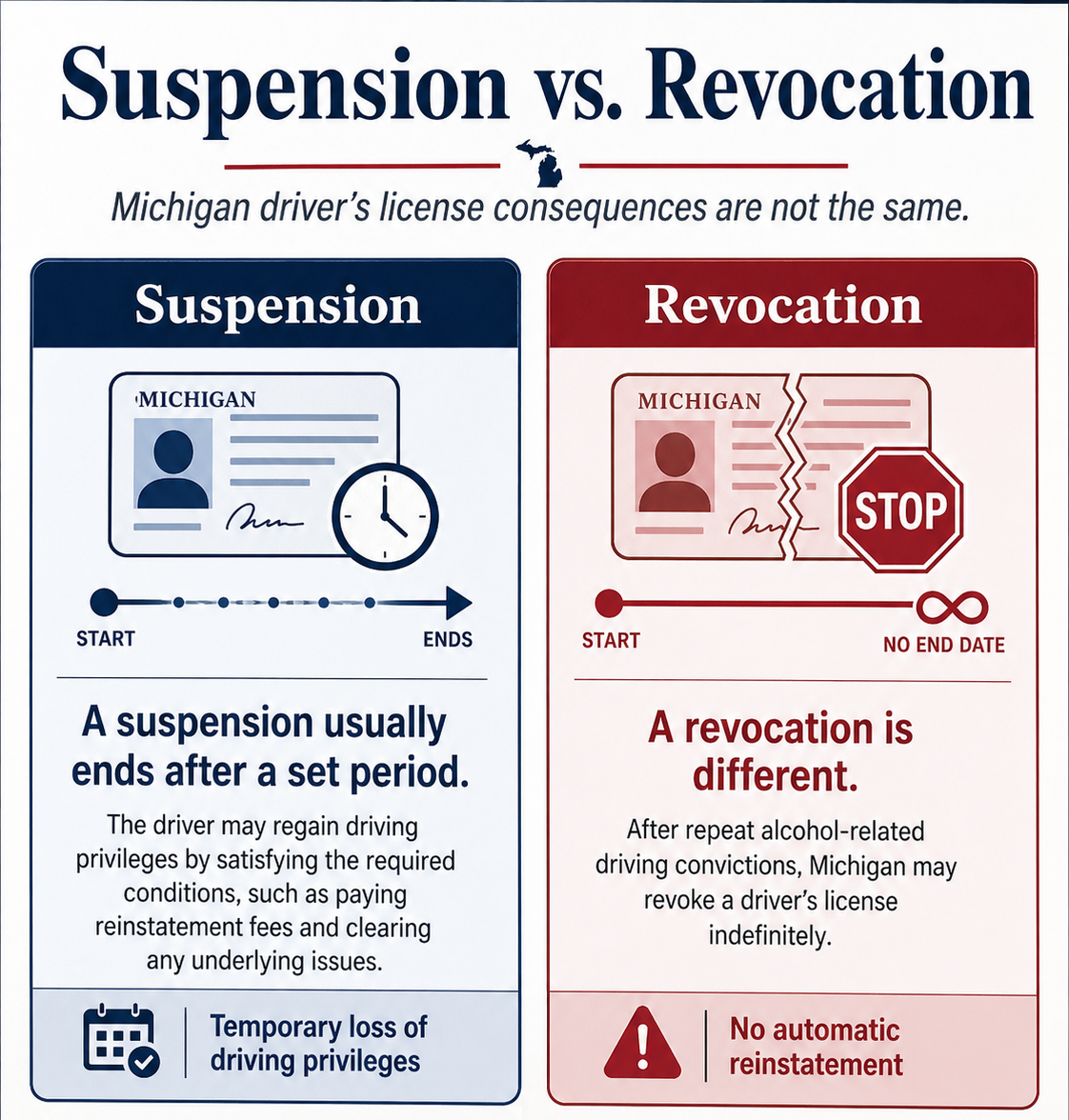
A suspension and a revocation are different. A suspension usually ends after a set period if the driver satisfies the required conditions, such as paying reinstatement fees and clearing any underlying issues. A revocation is different. After repeat alcohol-related driving convictions, Michigan may revoke the license indefinitely.
The driver may become eligible to apply after the statutory waiting period, but eligibility does not mean reinstatement. The driver must petition the Secretary of State, attend a hearing or proceed by administrative review, and prove the case. If the petition fails, the petitioner typically must wait another year before filing again.
The Burden of Proof Falls on the Petitioner
At a Michigan driver's license restoration hearing, the burden of proof is on the petitioner. The hearing officer does not have to prove that the driver remains unsafe. The driver must prove, by clear and convincing evidence, that any past alcohol or substance-use problem is under control and likely to remain under control. That proof must come from consistent documents, credible testimony, and a thoroughly prepared record.
The record built for the hearing is the case. Hearing officers decide based on what is in the file and what is said under oath. Sympathy does not factor in. A genuinely sober person can lose if the evidence is incomplete, inconsistent, or poorly assembled.
Building a Successful Restoration Case
A successful restoration case usually requires a current and properly prepared substance use evaluation, a valid drug screen completed within the required time frame, credible letters of support from people who can describe the petitioner's sobriety, an accurate and consistent sobriety history, and live or video testimony that lines up exactly with the written record.
If the petitioner attends AA, NA, SMART Recovery, formal counseling, or another support program, that involvement should be documented and explained. If the petitioner does not attend AA, the case still must show a stable and credible recovery plan. The Secretary of State does not require AA, but it does require a coherent answer to two questions: how has the petitioner stayed sober, and how will the petitioner stay sober going forward?
What the Hearing Officer Will Examine
The hearing officer reads everything. The most common areas of focus include the date of last alcohol or drug use and how confident the documents are about that date; any relapses since the last drink or use, and how those were handled; treatment or counseling completed, including any treatment recommendations not followed; whether support letters describe the same sobriety history as the petitioner; whether the substance use evaluation matches the testimony; the validity, timing, and completeness of the drug screen; whether the person has driven during the revocation period; and any new traffic citation that suggests unlawful driving.
These cases are often won or lost on preparation. A restoration hearing is not an informal request for sympathy. It is a formal administrative proceeding, recorded and decided under specific rules.
New Tickets Make the Problem Worse
Driving while revoked or suspended can deepen the hole. If a person is caught driving without valid privileges, the new case may bring criminal penalties and additional Secretary of State consequences. Even an apparently minor offense can become damaging if it is abstracted to the driving record and used as proof that the person drove during the revocation period. For background on those charges, see DWLS — driving while license suspended.
This is the cycle many revoked drivers know too well. They need to drive to work, but driving creates the risk of a new charge. A new charge can push the eligibility date farther away. The longer the person remains revoked, the more pressure there is to drive. Breaking that cycle requires a careful plan, not another rushed plea or a poorly prepared restoration filing.
Out-of-State Residents
Some people leave Michigan before resolving the license issue. That alone does not solve the problem. If Michigan maintains a hold on the driving record, another state may refuse to issue a license until Michigan clears the revocation. Out-of-state residents may be able to seek clearance through administrative review, which avoids the need to travel to Michigan for a hearing.
An administrative review can be useful because it relies entirely on documents. It can also be risky because there is no live testimony to correct misunderstandings or address weaknesses in the paperwork. Out-of-state evaluations and support letters must still be prepared with Michigan's specific requirements in mind. A poorly prepared administrative review can produce a denial that has to be unwound later.
Appeals After a Denial
If the Secretary of State denies a restoration appeal, the petitioner may have the right to seek review in circuit court. But a circuit court appeal is not a substitute for preparing the case correctly the first time. The court does not ordinarily conduct a new hearing where the petitioner can fix weak letters, correct an evaluation, or present better testimony. The court reviews the administrative record under a limited standard.
For most denied petitioners, the issue is not that the hearing officer abused discretion. The issue is that the record was not strong enough. In those cases, the better path is to study the denial in detail, fix the underlying problems, and prepare for the next filing. Circuit court appeals are appropriate when a hearing officer applies the wrong legal standard or improperly extends a legal doctrine, but those cases require careful review by counsel.
A Word About Guarantees
Because the process is hard, some lawyers advertise guarantees. A common promise is that if the lawyer does not win the first hearing, the lawyer will represent the client for free at the second hearing. That offer can sound reassuring, but it can also be misleading. The objective is not a free second hearing. The objective is to avoid losing the first hearing.
A denial is not harmless. It can cost another year. It creates a record of testimony, exhibits, and letters that must be explained later. A "free" second attempt does not erase the lost time, and it does not undo the damage caused by a poorly prepared first record. The right approach is to file only when the case is ready and to prepare the first hearing as if it is the only hearing that will ever happen.
Why Legal Preparation Matters
Hiring a lawyer is not required. A person may represent himself or herself at a Michigan driver's license restoration hearing. But the process is demanding, and mistakes have lasting consequences. The wrong documents, inconsistent sobriety dates, weak letters, an inadequate substance use evaluation, or inaccurate testimony can lead to denial and complicate later efforts.
A lawyer who regularly handles license restoration cases should help confirm eligibility, review the driving record, prepare the client for the substance use evaluation, examine the drug screen, edit support letters for clarity and consistency, address any prior denials, and prepare testimony. Equally important, the lawyer should be able to identify whether the case is ready to file or whether more preparation is needed before filing.
Conclusion and Next Steps
Michigan driver's license restoration is not simply a matter of waiting long enough, filling out forms, or explaining that driving is necessary. A revoked driver must prove sobriety, stability, and a low risk of future alcohol-related or drug-related driving. The case must be supported by credible documentation and truthful, consistent testimony.
If you are beginning the restoration process, the first step is to understand where you stand. Review the driving record. Confirm the eligibility date. Avoid new tickets. Prepare the substance use evaluation and support letters with care. Decide whether an in-person hearing, a video hearing, or an administrative review is appropriate for your situation. The process takes work, but for a person who is genuinely sober and properly prepared, restoring lawful driving privileges is achievable.
To learn more about specific parts of the process:
